
Riserva Naturale
Fontana del Guercio
History Pills

The reserve area has been recognized as a Site of Community Interest and a Special Area of Conservation.
Fontana del Guercio Nature Reserve (ZSC IT2020008)
1. General framework and official recognitions
The Fontana del Guercio Nature Reserve is a regional protected area established in 1986 by Regional Law No. 86 of November 30, 1986. Since 1995, it has also been recognized as a Site of Community Interest (SCI) and a Special Area of Conservation (SAC) with code IT2020008, thus becoming an integral part of the Natura 2000 Network, established pursuant to the Habitats Directive 92/43/EEC.
The aim of the Natura 2000 Network is to maintain biodiversity across Europe through the conservation of natural habitats and animal and plant species of community interest. The reserve covers an area of between 27.8 and 35 hectares (depending on the source), entirely within the municipality of Carugo (CO), and largely covered by forest.
2. Environmental characteristics and naturalistic value
The naturalistic peculiarities of the reserve are primarily hydrogeological. The terrain is characterized by the presence of the Ceppo Formation, a unique geological structure that is a key element for the presence of water. The Ceppo is a conglomerate: a rock formed from a mixture of naturally cemented pebbles, but with numerous empty spaces between the constituent elements. These empty spaces allow it to function like a sponge, absorbing water that accumulates and forms the aquifer.
Thanks to this geological composition, the reserve contains 11 natural springs (according to some sources, 14 fountains), used by man since ancient times, perhaps as early as the Celtic era. These fountains are partly artificial structures, dug and shaped by man, but naturally fed by the emerging aquifer.
3. The Fountains: Function, Structure, and Biodiversity
Among the most important springs in the reserve are:
the Fontana del Guercio, from which the entire area takes its name;
the Testa del Nan, one of the largest springs in Lombardy, the source of the Borromeo Canal;
the Capùn.
These fountains are bordered by ancient dry stone walls, built without mortar or cement. Some of these walls date back to the late 1600s and are today of great historical and naturalistic value. The spaces between the stones are home to various forms of life:
in sunny areas, the walls offer shelter to reptiles and small mammals;
in humid and shady areas, the stones are colonized by ferns and hygrophilous vegetation.
From a naturalistic perspective, the most interesting area of the fountain is the "head," where the water flows at a constant temperature (about 12°C). This condition favors the presence of animal and plant species adapted to stable temperatures. The points where the water emerges are called "springs" or "pools," and are easily recognized because the sand on the bottom is disturbed by the movement of the rising water.
4. The Borromeo Canal and the Running Water Ecosystem
The Borromeo Canal, which originates from Testa del Nan, runs through the entire reserve and is enclosed between splendid dry stone walls, also colonized by ferns and vegetation typical of wetland environments. It is a rare and precious example of a lotic water ecosystem, or running water.
In this type of habitat, the organisms that inhabit it have developed specific evolutionary strategies to adapt to the current and the "turbulent" conditions of the flow. The constant presence of water and its purity foster great biodiversity, both at the microbial and macroscopic levels. The waters of the marshy area were channeled in the 17th century to supply water to the villages downstream (Mariano Comense and Seregno) and to feed the fountains of Villa Borromeo in Cesano Maderno.
5. The Remaining Woodlands and the Brianza Landscape
The woodlands in the reserve represent some of the last vestiges of the ancient lowland oak forest, consisting of sessile oak, common oak, hornbeam, and other native tree species. This type of forest once covered much of the Po Valley, including Brianza and the Prealps, but was progressively destroyed starting in Roman times and then, massively, with industrialization and the reclamation of wetlands.
In the reserve, this forest survives thanks to the presence of the surface aquifer, which keeps the soil moist along the course of the irrigation ditch. It is now a rare and precious environment, a true ecological relic that must be carefully protected.
6. Public Access and Environmental Education
To promote awareness and appreciation of the area, a nature trail has been created, complete with eight educational panels illustrating the reserve's hydrogeological, botanical, faunal, and historical features. The trail is accessible and designed for educational and outreach purposes, and is often visited by schools, families, and nature groups.
7. Recent History: Degradation, Rebirth, and Volunteering
After World War II, with the industrial and artisanal boom that characterized Brianza, the area changed rapidly. Economic growth brought prosperity, but also a widespread abandonment of traditional sites. In those years, the Fontana del Guercio area was transformed into a landfill with municipal authorization: waste from manufacturing operations, debris, and various types of waste accumulated there, as a waste disposal center as we know it today had not yet been planned. The ancient space of springs and washhouses thus lost its original function and became a degraded area, a sign of the contradictions of the economic boom.
The turning point came in July 1974, in the midst of austerity. A group of young people and citizens of Carugo, driven by the desire to reclaim a place that was integral to the town's identity, spontaneously organized to clean up the area. Thus was born the "Amis de la Funtana" group, which for years carried out work days dedicated to waste removal and landscaping. What began as a practical initiative soon transformed into a community event, strengthening social bonds and instilling a sense of belonging. Every year for several years, the "Fontana Festival" was celebrated in July, with music and dancing, food, and a solemn mass.
From that experience, the core of local volunteerism also took shape: the same citizens who worked at the fountain formed the basis of the forest firefighting group and, later, the municipal Civil Protection Department, officially established in 1995.
Fifty years later, in 2024, this story was collected in a volume edited by the cultural association Museo della Brianza nel Novecento, with historical photographs and firsthand accounts. It is the memory of a unique journey: an abandoned and degraded area brought back to life thanks to the determination of a community.

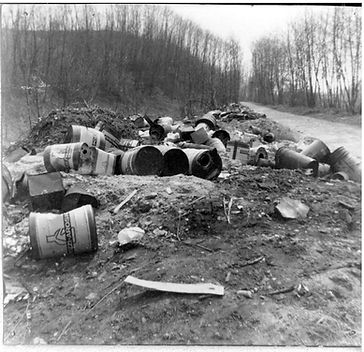
The area of the current Reserve in the 1970s